
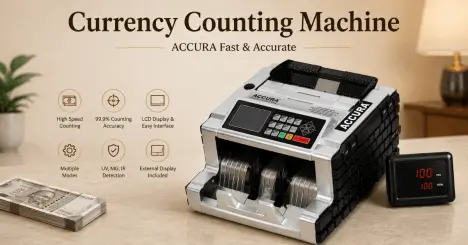
Handling physical cash remains a daily reality for a large number of Indian shops, clinics, restaurants, petrol pumps, educational institutions and small-to-medium businesses. Manual counting is slow, tiring and prone to human error, especially at the end of a busy day or during peak hours. A currency counting machine solves these problems by delivering speed, accuracy and built-in counterfeit detection in a compact desktop unit. For any business that regularly deals with stacks of notes, it quickly becomes one of the most useful pieces of equipment on the counter or in the back office.
A modern currency counting machine can process hundreds of notes per minute, display the total count, and, on more advanced models, calculate the total value when notes of different denominations are mixed. Multi-sensor counterfeit detection (ultraviolet, magnetic, infrared and dimension checks) helps identify suspicious notes before they enter the cash flow. The result is faster closing, fewer disputes and greater confidence in daily cash figures.
Why Businesses Need a Currency Counting Machine
Manual counting has clear limitations. Fatigue leads to miscounts. Large volumes take significant staff time that could be spent on customers. Counterfeit notes can slip through visual inspection, especially under poor lighting or time pressure. In businesses with multiple cashiers or shifts, reconciling cash becomes time-consuming and occasionally contentious.
A currency counting machine addresses each of these issues. Notes are fed into a hopper, processed at high speed, and the total is displayed clearly. Many machines stop automatically when a suspicious note is detected, allowing immediate inspection. Batch counting functions help prepare bank deposits or cash drawers for the next shift. Over weeks and months the time saved and errors avoided more than justify the investment for any operation that handles meaningful volumes of cash.
Core Functions and Useful Features
When selecting a currency counting machine, focus on these practical capabilities:
- Counting speed: Most business-grade machines process 600–1,200 notes per minute. Higher speeds reduce end-of-day workload.
- Counterfeit detection: Look for multiple sensors — ultraviolet (UV) for fluorescent security features, magnetic (MG) for magnetic ink, infrared (IR) for pattern recognition, and dimension or thickness checks. Multi-sensor systems are significantly more reliable than single-method detection.
- Value counting / mixed denomination: Advanced models identify different denominations in a single pass and display both the number of notes and the total monetary value. This is especially useful when cash is not pre-sorted.
- Batch and add functions: Batch mode counts a pre-set number of notes (for example, 100) and pauses. Add mode keeps a running total across multiple stacks.
- Hopper and stacker capacity: A hopper that holds 200–300 notes and a stacker of similar size allows continuous operation with fewer interruptions.
- Display and controls: A clear LED or LCD screen and simple button layout reduce training time and operator errors.
- Error detection: The machine should alert for double notes, chained notes or half notes.
- Build quality and reliability: A sturdy desktop design that can handle daily commercial use is more important than decorative features.
Basic counting-only machines suit low-volume users. Businesses that handle mixed notes or want stronger counterfeit protection benefit from value-counting models with multi-sensor detection.
Practical Benefits in Daily Operations
The most immediate benefit is speed. What once took 15–20 minutes of careful manual counting can often be completed in one or two minutes. Staff can close the counter faster, prepare bank deposits more quickly, and return to productive work. Accuracy improves because the machine does not suffer from fatigue or distraction. Disputes over cash totals become less frequent when an objective count is available.
Counterfeit detection adds a second layer of value. Even a small number of fake notes can cause financial loss and administrative hassle. Automatic detection reduces the chance of accepting them and provides a clear point at which a note can be set aside for further checking. For businesses that deposit cash regularly, cleaner deposits also mean fewer issues with the bank.
In multi-cashier environments the machine creates a consistent standard. Every shift can use the same device, reducing variation in counting methods. Some owners keep a simple log of machine counts alongside manual verification for the first few weeks until confidence is established.
Placement and Daily Use Tips
Place the currency counting machine on a stable, level surface with enough space for feeding notes and removing the counted stack. Keep it away from direct sunlight, excessive dust and moisture. Most units run on standard power and require little warm-up time.
Develop a simple routine: fan the notes lightly to separate them, remove obvious damaged or folded notes, load the hopper, select the desired mode (count, value, batch), and start. When the machine stops for a suspicious note, inspect it carefully under good light. Clean the sensors periodically according to the manufacturer’s guidance — dust is the most common cause of reduced detection performance.
Train at least two staff members so that operation does not depend on a single person. Keep the original packaging or a protective cover for times when the machine is not in daily use.
Common Mistakes to Avoid
Buying the cheapest machine without checking sensor quality often leads to frequent false rejects or missed counterfeits. Ignoring regular cleaning reduces accuracy over time. Overloading the hopper or feeding wet, excessively crumpled or taped notes increases jams and errors. Expecting the machine to replace all human oversight is unrealistic — it is a powerful tool, not a complete substitute for basic cash-handling discipline. Choosing a machine that is too slow or lacks value-counting features for a high-volume mixed-note environment creates ongoing frustration.
Conclusion
A currency counting machine brings speed, accuracy and counterfeit protection to any business that regularly handles physical cash. High counting rates, multi-sensor detection and useful functions such as value counting and batch mode turn a time-consuming chore into a quick, reliable process. For shops, offices and service businesses across India, it is one of the most practical productivity upgrades available.
ACCURA currency counting machines are built for exactly these everyday commercial needs. ACCURA models deliver fast and accurate counting, multi-sensor counterfeit detection (including UV, MG and IR technologies), clear displays, practical batch and add functions, and durable construction suitable for regular business use. Whether you need a straightforward note counter for a small shop or a value-counting machine for higher volumes, ACCURA provides dependable performance that helps businesses close faster, reduce errors and handle cash with greater confidence. Supported by clear guidance and service backup, an ACCURA currency counting machine is a practical long-term tool for efficient cash management.
FAQs
Q: How fast can a currency counting machine process notes? A: Most business models count between 600 and 1,200 notes per minute, depending on the mode and note condition.
Q: What types of counterfeit detection should I look for? A: Multi-sensor systems that combine ultraviolet (UV), magnetic (MG), infrared (IR) and dimension checks provide the most reliable protection.
Q: Can the machine count mixed denominations and show the total value? A: Advanced models offer value-counting mode that identifies different denominations in one pass and displays both quantity and total amount.
Q: Is a currency counting machine useful for small shops? A: Yes. Even modest daily volumes benefit from faster closing, fewer counting errors and basic counterfeit detection.
Q: How should I maintain the machine for reliable performance? A: Keep it clean, especially the sensors, avoid feeding damaged or wet notes, and follow the manufacturer’s guidance for periodic maintenance.