
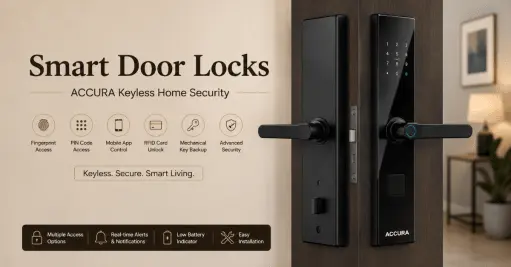
The front door is the primary barrier between a home and the outside world. Traditional mechanical locks have served for decades, yet they come with familiar limitations: keys can be lost, duplicated or locked inside, and sharing access with family members or trusted helpers requires physical key copies. Smart door locks address these issues by combining electronic access methods — fingerprint, PIN code, and often mobile-app control — with a reliable mechanical key override. The result is greater convenience for authorised users and stronger control over who can enter the home.
Smart door locks have moved from luxury gadgets to practical security upgrades for Indian apartments and independent houses. When chosen and installed correctly, they reduce dependence on physical keys, allow temporary access for guests or service staff, and integrate into a broader home security approach that may also include CCTV cameras and a securely mounted home locker.
Why Homeowners Are Switching to Smart Door Locks
Key management is a daily friction point. Family members misplace keys, domestic staff need controlled access, and guests or delivery personnel sometimes require temporary entry. Mechanical locks offer no easy way to grant or revoke access without collecting keys. Smart door locks solve this by letting the homeowner register multiple fingerprints, set permanent or temporary PIN codes, and, on connected models, manage access from a phone.
Security also improves in practical ways. There is no keyhole for traditional lock-picking techniques on many designs, and auto-locking features ensure the door secures itself after closing. Activity logs on app-enabled models provide visibility into when the door was opened and by which method. For households that already use biometric or digital home lockers, a smart door lock creates a consistent, modern access experience across the property.
How Smart Door Locks Work
Most residential smart door locks replace or work alongside the existing mechanical lock. Common access methods include:
- Fingerprint recognition: A sensor reads the unique pattern of a registered finger and unlocks the door in about a second. Multiple fingerprints can usually be stored for family members.
- PIN code: A keypad accepts a numeric code. Permanent codes can be given to regular users; temporary or one-time codes can be issued for guests or service providers and later deleted.
- Mobile app / Bluetooth: Some models allow unlocking via a paired smartphone when the user is near the door. Remote unlocking over the internet is available on certain Wi-Fi or hybrid models, though it requires careful security settings.
- Mechanical key override: A physical key remains available for emergencies, power failure, or complete electronic malfunction. This backup is essential.
Power is typically supplied by batteries that last several months to over a year under normal use. Low-battery warnings appear on the lock or in the app so replacement can be planned. Many locks automatically re-lock after a few seconds if the door is closed, reducing the risk of an unlocked door being left open.
Key Features to Evaluate
When choosing smart door locks, consider these practical points:
- Multiple access methods: Fingerprint + PIN + mechanical key is the most reliable combination for daily residential use.
- Build quality and weather resistance: The lock body and keypad or sensor should withstand regular use and, for main doors, outdoor exposure.
- Battery life and indicators: Long battery life and clear low-battery alerts prevent unexpected lockouts.
- User capacity: The ability to store multiple fingerprints and PIN codes suits families and homes with domestic help.
- Auto-lock and passage mode: Auto-lock improves security; a temporary passage mode is useful when moving items in and out.
- App features (where present): Access logs, temporary codes, and remote status checks add convenience but should not be the sole access method.
- Compatibility: Confirm the lock fits the existing door thickness and door-frame preparation, or be prepared for minor carpentry work.
- Emergency access: Mechanical key override and, on some models, external power contacts for dead batteries are important safeguards.
Both pure digital and biometric-focused models work well. Biometric access is fastest for regular users; PIN access is simple to share and revoke. App connectivity is useful but secondary to reliable local access methods.
Installation and Placement Considerations
Most smart door locks are designed for standard Indian main doors and bedroom doors. Professional installation is recommended to ensure correct alignment, secure fixing, and proper weather sealing on external doors. The lock should be positioned at a comfortable height for fingerprint use and keypad operation.
After installation, register primary fingerprints carefully, set a strong master PIN, create any additional user codes, and test the mechanical key. Store the physical keys in a secure location separate from the door. If the model includes an app, complete the pairing process and enable any available security features such as two-factor authentication.
For main entrance doors, consider pairing the smart lock with a good-quality door frame, a door viewer or camera, and adequate external lighting. The lock is only one layer; the overall door assembly and surrounding security measures matter equally.
Everyday Benefits for Indian Households
Smart door locks remove the daily hassle of carrying and managing keys. Family members gain fast, keyless entry. Temporary codes can be given to domestic staff, drivers or guests and deleted when no longer needed. Parents can monitor entry activity when children return from school. Travellers can grant limited access to a trusted neighbour if required.
Security improves through auto-locking, the absence of a traditional keyhole on many designs, and the ability to change codes instantly if a temporary user no longer needs access. When combined with CCTV cameras covering the entrance and a bolted home locker for valuables, the smart door lock becomes part of a coherent layered security system.
Common Mistakes to Avoid
Buyers sometimes choose locks that rely solely on a smartphone app without reliable local fingerprint or PIN access. Others neglect the mechanical key override or store the physical keys poorly. Installing on a weak or poorly fitting door reduces overall security. Using simple, easily guessed PIN codes or failing to delete temporary codes creates avoidable risk. Expecting the lock alone to secure a home without attention to the door, frame and surrounding measures is another frequent error.
Conclusion
Smart door locks bring keyless convenience and stronger access control to modern Indian homes. Fingerprint recognition, PIN codes, optional app features and a mechanical key backup combine to reduce key-related friction while improving everyday security. When installed on a solid door and used as part of a broader approach that includes surveillance and secure storage for valuables, they form a practical and effective upgrade.
ACCURA smart door locks are designed for reliable residential use in Indian conditions. ACCURA models emphasise multiple access methods (fingerprint, PIN and mechanical key override), solid construction, practical battery life, clear user management and straightforward operation. Whether fitted on a main entrance or an internal door, an ACCURA smart door lock delivers keyless convenience without sacrificing backup access or build quality. Supported by clear guidance and service backup, ACCURA helps households move to modern, controlled entry while maintaining the security fundamentals that matter most.
FAQs
Q: What access methods do smart door locks usually offer? A: Most quality residential models combine fingerprint recognition, PIN codes and a mechanical key override. Some also include mobile-app unlocking.
Q: What happens if the batteries die? A: Use the mechanical key override. Low-battery warnings give advance notice so batteries can be replaced before complete failure.
Q: Can I give temporary access to guests or domestic staff? A: Yes. Temporary or one-time PIN codes can be created and later deleted without affecting permanent users.
Q: Are smart door locks suitable for main entrance doors? A: Yes, provided the lock is designed for external use, the door and frame are solid, and installation is done correctly.
Q: Do smart door locks work during a power cut? A: Yes. They run on batteries, not household electricity. The mechanical key remains available as a final backup.