
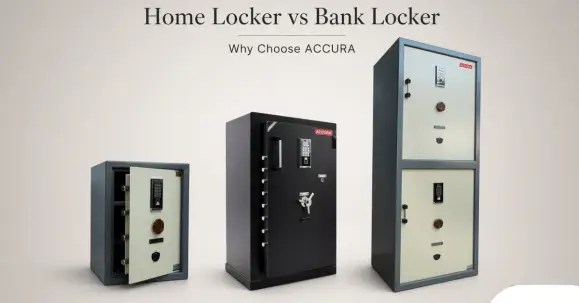
The debate between a home locker vs bank locker is one of the most common security questions Indian families face. Both options aim to protect jewellery, cash, property documents, passports and other valuables, yet they differ sharply in accessibility, cost, control and day-to-day convenience. Understanding these differences helps households decide what works best for frequent-use items versus rarely accessed heirlooms.
A bank locker is a rented compartment inside a bank’s strong room. Access requires visiting the branch during banking hours, presenting identification, and often waiting for staff availability. A home locker, by contrast, is a steel safe installed inside the residence. It remains under the owner’s direct control and can be opened at any hour using PIN, fingerprint or key, depending on the model.
Accessibility: The Biggest Practical Difference
Bank lockers operate only during fixed banking hours and are closed on Sundays, public holidays and sometimes during staff shortages. If you need jewellery for a last-minute function, an emergency medical document, or cash late at night, the bank is simply unavailable. Waiting lists for new bank lockers remain long in many cities, and existing customers may face limits on the number of visits allowed per month.
A home locker removes these restrictions completely. Once installed and bolted, it can be opened whenever needed — midnight, early morning, or during a festival. Families with elderly members or those who travel frequently find this independence particularly valuable. The ability to retrieve items without travel time or coordination with bank staff is one of the strongest arguments in the home locker vs bank locker comparison.
Cost Over Time
Bank lockers involve recurring annual rent that varies by size and city, often ranging from a few thousand rupees upward, plus a mandatory fixed deposit or security amount in many cases. Over five or ten years these charges accumulate. There may also be incidental costs for extra visits or documentation.
A home locker is a one-time purchase. After the initial investment there are no annual fees. Battery replacement for digital or biometric models is inexpensive and infrequent. When the long-term cost of repeated bank rentals is calculated against the one-time price of a quality steel home locker, the home option frequently proves more economical for items that are accessed regularly.
Security Features Compared
Bank strong rooms offer institutional-level physical security, surveillance and dual-key systems. However, banks typically limit their liability for the contents. Customers are advised to insure high-value items separately. Access is controlled, yet the process still depends on bank staff and procedures.
A well-built home locker relies on thick steel construction (commonly 3 mm body and 6 mm door), dual or triple locking (mechanical key plus digital PIN or biometric fingerprint), and proper bolting to the wall or floor. Once bolted, the unit cannot be easily removed. Tamper alarms, wrong-attempt lockouts and low-battery indicators add further layers. While a home locker does not match the multi-layered infrastructure of a bank vault, it places security under the family’s direct control and eliminates dependence on third-party procedures.
For daily-use jewellery, emergency cash and frequently needed documents, the combination of physical strength and immediate access often outweighs the institutional security of a bank locker. Many households therefore adopt a hybrid approach: rarely touched heirlooms and large volumes of gold remain in the bank, while items needed for regular life stay in a home locker.
Control, Privacy and Liability
With a bank locker the contents are known only to the customer, yet access still requires interaction with bank personnel. Inheritance or emergency situations can become complicated if the key holder is unavailable or paperwork is incomplete.
A home locker remains entirely private. Only registered users (via fingerprint or PIN) or those with the emergency key can open it. Family members can be given controlled access without involving external institutions. Liability rests with the owner, which encourages proper insurance of high-value contents — a step recommended regardless of storage method.
Convenience for Modern Indian Households
Urban lifestyles, dual-income families and the rising value of gold have increased the need for quick access. Festivals, weddings, sudden travel and medical emergencies rarely align with banking hours. A home locker solves this mismatch. Digital and biometric models further improve usability: fingerprints open the door in under a second, multiple family members can be registered, and the emergency key provides a reliable backup.
Placement flexibility is another advantage. The locker can be installed in a bedroom, wardrobe or storage area according to convenience and Vastu preferences. Once bolted, it becomes a permanent, low-maintenance part of the home’s security setup.
When a Bank Locker Still Makes Sense
Bank lockers remain suitable for items that are almost never accessed — large volumes of jewellery kept purely as long-term assets, original property deeds that are rarely required, or valuables intended strictly for inheritance. The institutional environment and restricted access can feel more appropriate for such passive storage. However, for anything needed more than a few times a year, the practical limitations of bank lockers become apparent.
Common Mistakes in the Decision Process
Some families keep everything in the bank and suffer repeated inconvenience. Others buy an unbolted, thin-walled home safe and assume it offers bank-level protection. The better approach is to evaluate actual usage frequency, calculate long-term costs, and match the storage method to the items. High-frequency items belong at home; low-frequency high-value assets can stay in the bank if preferred.
Conclusion
The home locker vs bank locker decision ultimately depends on how often valuables need to be accessed and how much control and convenience the family prioritises. For daily jewellery, emergency cash, passports and frequently required documents, a properly constructed and bolted home locker delivers clear advantages in accessibility, long-term cost and personal control.
ACCURA home lockers are designed precisely for these everyday Indian household needs. ACCURA models feature robust mild-steel construction with typical 3 mm body and 6 mm door thickness, single-sheet moulding, powder-coated rust-resistant finishes, dual locking systems (digital PIN or biometric fingerprint plus emergency mechanical key), pre-drilled mounting holes for secure bolting, and practical internal layouts. Whether you choose a compact digital unit or a larger biometric model, ACCURA provides reliable protection without annual rent or restricted access hours. Supported by clear installation guidance and multi-year service backup, ACCURA home lockers offer a practical, permanent alternative that keeps your valuables secure and accessible whenever you need them.
FAQs
Q: Is a home locker safer than a bank locker? A: Bank vaults offer institutional security, but a well-built, bolted home locker with dual locking provides strong protection under your direct control and 24/7 access. Many families use both for different items.
Q: What is the long-term cost difference? A: Bank lockers involve annual rent that accumulates over years. A home locker is a one-time purchase with only occasional battery costs.
Q: Can I access a home locker at any time? A: Yes. Once installed, a home locker can be opened 24 hours a day, including nights, weekends and holidays.
Q: Should I still insure items kept in a home locker? A: Yes. Insurance is recommended for high-value contents regardless of whether they are stored at home or in a bank.
Q: What size home locker is suitable as an alternative to a bank locker? A: Medium family sizes (around 35–45 litres) handle jewellery, documents and cash for most households. Larger units suit extensive collections or home-office use.