
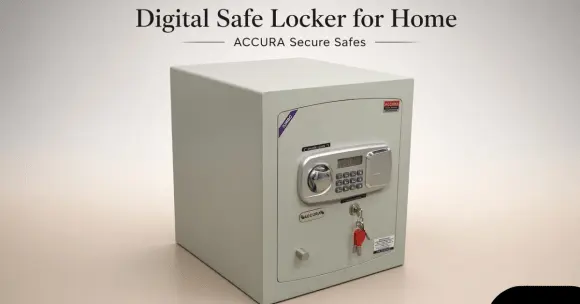
In today’s Indian households, valuables are no longer limited to a few pieces of jewellery or a small cash reserve. Families routinely store gold sets, emergency cash, property documents, passports, insurance papers, fixed-deposit receipts and digital gadgets that hold sensitive data. Traditional wooden cupboards and ordinary drawers offer almost no real resistance against determined theft or accidental fire. This is exactly why a digital safe locker for home has become one of the most practical security upgrades a family can make.
A digital safe for home replaces the old mechanical key system with an electronic PIN keypad while still retaining a physical emergency key as backup. The result is fast daily access combined with strong physical protection. You no longer need to search for a hidden key or worry about keys being duplicated. At the same time, the emergency override key ensures you are never permanently locked out if the batteries fail or the electronics encounter a temporary issue.
Why Indian Homes Are Switching to Digital Safety Lockers
Three clear trends have accelerated demand. First, the sharp rise in gold prices has turned even modest jewellery collections into high-value targets. Second, urban and semi-urban burglary patterns show that most thieves look for quick, portable items — a properly bolted digital safe stops them. Third, bank lockers continue to suffer from long waiting lists, restricted banking hours and annual rental costs. A digital safe locker for home removes all three problems at once: it sits inside your house, remains accessible 24 hours a day, and involves only a one-time purchase.
Unlike mechanical lockers that rely solely on keys, a digital model lets every authorised family member use the same PIN or their own code (depending on the model). This is especially useful in joint families or homes with domestic staff where sharing physical keys creates risk.
How a Digital Safe Locker Actually Works
Most digital lockers for home run on standard AA batteries that typically last 12–24 months under normal use. When you enter the correct PIN (usually 4 to 8 digits) and press the confirmation button, motorised or mechanical bolts retract and the door opens. Many units include an automatic re-lock feature so the door secures itself if left ajar for a few seconds.
If the batteries eventually die, the emergency override key — stored separately in a secure place — allows you to open the locker and replace the batteries. Some advanced designs also offer an external power contact that can be temporarily powered by a 9-volt battery so you can still enter the PIN without opening the key cover. Low-battery indicators (usually a flashing light or beep) give advance warning so lockouts are rare when the unit is maintained properly.
Security features commonly include auto-lockout after three or more wrong PIN attempts. This freezes the keypad for 20 seconds to several minutes and discourages guessing attacks. Combined with thick steel construction, these electronic protections make forced entry significantly harder than with ordinary furniture.
Key Features That Separate a Good Digital Safe from a Weak One
When evaluating any digital locker for home, focus on these practical points:
- Steel thickness and construction: Look for a body of at least 2–3 mm and a door of 5–6 mm. Single-sheet moulding and powder-coated finishes resist rust in humid Indian climates and improve overall rigidity.
- Dual locking system: PIN keypad plus physical emergency key is non-negotiable. Relying only on electronics creates unnecessary risk.
- Pre-drilled mounting holes: Bolting the locker to a wall or floor is the single biggest security improvement. An unbolted safe can be carried away; a bolted one cannot.
- Internal organisation: Shelves or compartments help separate jewellery, documents and cash so items stay organised and undamaged.
- Alarm and indicators: Tamper alarms and low-battery warnings add an extra layer of awareness.
- User capacity: Models that allow multiple PINs or easy reprogramming suit families better than single-code units.
Size selection is equally important. Compact 12–20 litre units fit comfortably inside wardrobes or bedside cabinets and suit jewellery plus a few documents. Medium 30–40 litre models handle full family jewellery collections, passports for several members and important paperwork. Larger 50+ litre units work well for home offices or small business cash handling.
Practical Placement and Installation Tips
Place the digital locker for home in a location that balances security and convenience. Master bedrooms, walk-in wardrobes or a dedicated storage cupboard are common choices. Avoid obvious spots near the main entrance. Follow Vastu preferences if they matter to your family — many households prefer the south-west or north-east zones.
Always bolt the unit. Use the provided anchors and ensure the wall or floor can take the load. Once mounted, test the PIN, the override key and the low-battery indicator. Keep the emergency key in a separate secure location known only to trusted family members. Change the factory default PIN immediately after installation and avoid obvious sequences such as birth years or repeated digits.
Battery replacement is simple: open the door with the key or current PIN, locate the battery compartment (usually on the inner door), replace the cells with fresh ones of the correct type, and close the compartment. Most owners check the batteries every six months as a routine habit.
Real Everyday Benefits
A digital safe locker for home delivers measurable advantages. You gain instant access during festivals, medical emergencies or sudden travel needs without depending on bank timings. Children or elderly family members can be given limited access without handing over physical keys. The risk of key loss or unauthorised duplication drops sharply. Over five to ten years the one-time cost of a quality digital locker is almost always lower than cumulative bank locker rentals plus the inconvenience of travel and waiting.
For small shop owners or professionals who handle cash at home, the same unit doubles as a secure overnight cash box. Documents remain protected from casual viewing by visitors or household staff. In the event of a minor fire or water leakage, the steel enclosure provides far better protection than ordinary furniture.
Common Mistakes to Avoid
Many first-time buyers focus only on price and end up with thin-walled imported boxes that fail within months. Others skip bolting the locker, defeating much of its purpose. Some never change the default PIN or store the emergency key inside the safe itself. Avoid these errors by treating the purchase as a long-term security investment rather than a disposable gadget.
Conclusion
A digital locker for home is no longer a luxury — it is a practical necessity for protecting jewellery, cash and important documents in modern Indian households. The combination of convenient PIN access, reliable emergency key override, thick steel construction and proper mounting delivers security that ordinary cupboards simply cannot match.
ACCURA has built its reputation on exactly these principles. ACCURA digital lockers for home feature robust mild-steel bodies with 3 mm body and 6 mm door thickness, single-sheet moulding, powder-coated rust-resistant finishes, dual locking systems (digital PIN plus emergency key), pre-drilled mounting holes, and thoughtful internal layouts. Models range from compact wardrobe-friendly sizes to larger family and office-capable units. ACCURA supports customers with clear installation guidance, multi-year service backup and a focus on real-world Indian usage conditions. When you choose an ACCURA digital safe for home, you invest in daily convenience, long-term protection and the peace of mind that comes from knowing your valuables are secured by a brand that understands the needs of Indian families.
FAQs
Q: How long do the batteries last in a digital locker for home? A: Under normal household use, quality AA batteries typically last 12–24 months. Low-battery indicators give advance warning.
Q: What happens if the batteries die completely? A: Use the emergency override key to open the locker, replace the batteries, and resume normal PIN operation. Some models also support temporary external power.
Q: Can multiple family members use different PINs? A: Many digital models allow a master PIN plus additional user codes. Check the specific ACCURA model for multi-user capacity.
Q: Is it necessary to bolt the digital safe to the wall or floor? A: Yes. Bolting is one of the most effective ways to prevent the entire unit from being removed during a break-in.
Q: What size digital safe for home should I choose? A: 15–20 litres for personal jewellery and documents; 30–40 litres for full family needs; larger if you also store cash or business papers.