
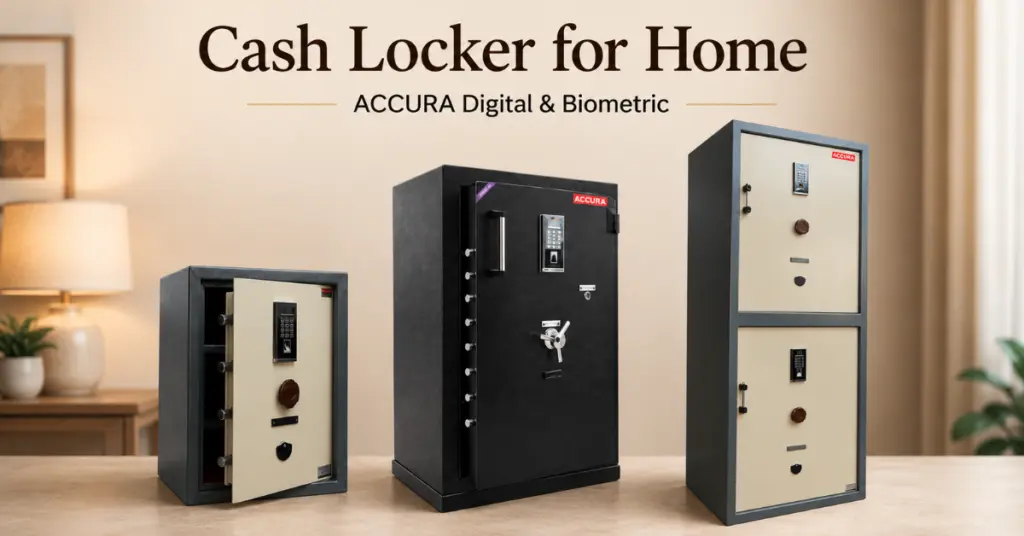
Cash remains a practical necessity in many Indian households and small businesses. Emergency funds, daily expenses, festival reserves, rental payments and business takings are still handled in physical currency. Keeping large or even moderate amounts of cash in drawers, cupboards or under mattresses exposes it to theft, accidental loss, fire and unauthorised access by household members or visitors. A dedicated cash locker for home solves this problem by providing secure, controlled and convenient storage that is available whenever needed.
A cash locker for home is a steel safe sized and configured primarily for currency notes, often with additional space for related documents or a limited amount of jewellery. Digital PIN or biometric fingerprint access combined with an emergency mechanical key allows quick authorised entry while maintaining strong physical protection. When properly bolted to a wall or floor, it becomes a reliable daily security tool for families and small shop owners alike.
Why a Dedicated Cash Locker Makes Sense
Many households keep emergency cash for medical needs, sudden travel or power outages. Small business owners and professionals who receive cash payments often bring takings home overnight. In both cases the risks are similar: opportunistic theft, internal leakage, and damage from fire or water. Ordinary furniture offers almost no resistance. Bank lockers restrict access to banking hours and involve recurring costs, making them impractical for money that may be needed at short notice.
A cash locker for home removes these limitations. It stays under the family’s or owner’s direct control, can be opened at any hour, and provides a clear separation between everyday cash and other valuables. Organised storage also reduces the chance of notes being misplaced or mixed with personal items.
Ideal Capacity and Internal Organisation
Cash volume varies widely. A compact 15–25 litre locker suits most households for emergency reserves and limited daily cash. Medium 30–40 litre units handle higher volumes typical of small shops, clinics or home-based businesses, with room for related receipts or documents. Larger sizes are appropriate when significant overnight cash holdings are routine.
Internal features that help with cash management include:
- Flat shelves or compartments that keep note bundles organised
- Enough depth to store bundles without excessive folding
- Separate sections if documents or a small amount of jewellery are also stored
Overfilling should be avoided. Notes stored under pressure crease and become harder to count later. A well-sized cash locker for home allows neat stacking and quick visual checks.
Essential Security and Access Features
When choosing a cash locker for home, prioritise these elements:
- Steel construction: Body thickness of at least 2–3 mm and door thickness of 5–6 mm provide meaningful resistance to prying and drilling. Single-sheet moulding and powder-coated finishes improve durability.
- Dual locking system: Digital PIN keypad or biometric fingerprint scanner plus an emergency mechanical key is strongly recommended. Auto-lockout after repeated wrong attempts adds protection.
- Mounting capability: Pre-drilled holes for wall or floor bolting are essential. An unbolted locker can still be removed.
- Battery reliability: Low-battery indicators and easy internal battery access prevent unexpected lockouts.
- Tamper alerts: Vibration or wrong-attempt alarms increase awareness.
- Quick authorised access: Biometric models open in under a second for registered users; digital PIN models are simple for multiple authorised people to use.
Both digital and biometric options work well for cash storage. Biometric access is particularly convenient when the same person handles cash frequently. Digital PIN access suits households or small teams where several trusted individuals need entry. In all cases the emergency key must be stored separately.
Placement and Daily Use Practices
Locate the cash locker for home in a discreet yet accessible area — typically a master bedroom, secure cupboard or home-office corner. Avoid obvious spots near the main entrance or high-traffic zones. Ensure the position allows comfortable operation of the keypad or scanner and full door opening.
Bolting is mandatory. Use appropriate anchors for the wall or floor type. After installation, change any default codes, register fingerprints if applicable, test the emergency key, and establish a simple routine for depositing and withdrawing cash. Many owners keep a basic log of major deposits and withdrawals for personal accounting.
For small business use, the same locker can serve as an overnight cash safe. End-of-day takings are secured at home and banked the next working day. This reduces the risk of leaving large amounts on business premises after hours.
Practical Benefits
A properly chosen cash locker for home delivers several clear advantages. Physical cash is protected against casual theft and internal leakage. Access remains available 24 hours a day without bank dependence. Organisation improves, making it easier to know exactly how much emergency or business cash is on hand. The one-time cost is typically lower than years of bank locker rentals, while control stays entirely with the owner.
In the event of a minor fire or water incident, the steel enclosure offers better protection than ordinary drawers. Combined with good household habits — limiting the amount of visible cash and using the locker consistently — the overall risk profile improves significantly.
Common Mistakes to Avoid
Buyers sometimes choose an undersized unit and then overfill it, making notes difficult to manage. Others skip bolting or use weak fasteners. Storing the emergency key inside the locker itself defeats the backup purpose. Relying on a single locking method (only PIN or only key) creates unnecessary vulnerability. Selecting a thin-walled imported box for the sake of low price often results in poor long-term security. Matching capacity, construction and dual locking to actual cash volume prevents these problems.
Conclusion
A cash locker for home provides focused, convenient and strong protection for the physical currency that many Indian households and small businesses still rely on. Adequate capacity, dual locking, solid steel construction and secure mounting combine to create a practical daily security solution.
ACCURA cash lockers for home are designed with these real-world needs in mind. ACCURA models feature robust mild-steel construction (typically 3 mm body and 6 mm door), single-sheet moulding, powder-coated rust-resistant finishes, dual locking systems (digital PIN or biometric fingerprint plus emergency mechanical key), pre-drilled mounting holes for secure bolting, and practical internal layouts suitable for note bundles and related items. Whether you need a compact unit for household emergency cash or a medium-sized model for small-business overnight holdings, ACCURA offers reliable protection backed by clear installation guidance and multi-year service support. Choosing an ACCURA cash locker for home means keeping your currency secure, organised and accessible under your own control.
FAQs
Q: What size cash locker for home do most households need? A: 15–25 litres is sufficient for emergency reserves and limited daily cash. 30–40 litres suits higher volumes or small-business overnight takings.
Q: Is biometric access useful for a cash locker? A: Yes. Fingerprint recognition allows very fast authorised access, which is convenient when cash is handled frequently. It should still be paired with an emergency key.
Q: Can the same locker hold documents as well as cash? A: Yes. Many models have enough space for both, provided the internal layout is used to keep notes and papers organised separately.
Q: Must a cash locker be bolted down? A: Yes. Bolting is one of the most important steps to prevent the entire unit from being removed during a break-in.
Q: How should cash be stored inside to stay organised? A: Stack notes in neat bundles by denomination where possible and avoid overfilling. Use shelves or compartments to separate cash from documents.