
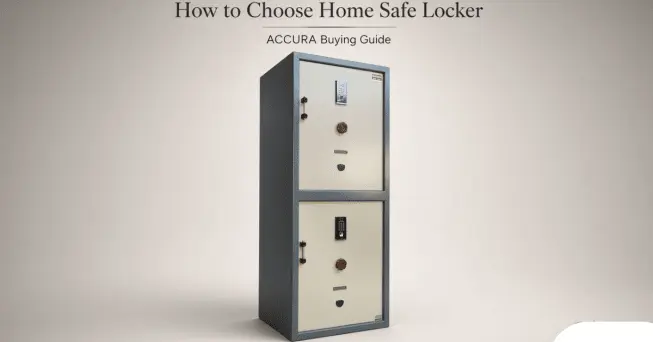
Choosing the right home safety locker is one of the most important security decisions an Indian family can make. With rising gold prices, increasing urban theft risks and the inconvenience of bank lockers, more households are installing steel safes at home. Yet many buyers focus only on price or appearance and end up with a unit that fails to deliver real protection. Knowing how to choose home safe locker correctly — based on capacity, construction, locking system, mounting and practical features — ensures the investment actually secures jewellery, cash, documents and other valuables for years.
A quality home safety locker should combine physical strength, reliable access methods and everyday usability. The goal is not simply to own a metal box, but to create a secure, accessible storage point that fits the family’s specific needs and living space.
Step 1: Determine What You Need to Store and How Often
Begin by listing the items that will go inside. Typical contents include:
- Jewellery (daily-wear sets versus full family collections)
- Emergency cash
- Passports, Aadhaar, PAN and property documents
- Insurance policies, fixed-deposit receipts and wills
- Small electronics or external drives with sensitive data
Estimate volume and frequency of access. Items needed several times a month (festival jewellery, emergency cash, travel documents) require convenient digital or biometric access. Rarely touched heirlooms can tolerate slower mechanical systems. This inventory directly guides size and locking-type decisions when learning how to choose home safe locker.
Step 2: Select the Right Capacity
Home safety lockers are commonly measured in litres or by external dimensions. Practical size guidelines for Indian homes are:
- 12–20 litres: Suitable for personal jewellery, a few passports and limited cash. Fits easily inside wardrobes or bedside cabinets.
- 30–40 litres: Ideal for most families — full jewellery collections, documents for several members and emergency cash.
- 50 litres and above: Better for joint families, home offices or those who also store business papers and larger cash volumes.
Always choose slightly larger than current needs. Jewellery collections and document piles tend to grow. An overly tight locker leads to poor organisation and frequent rearrangement.
Step 3: Evaluate Steel Thickness and Build Quality
Physical resistance is the foundation of any safe. Look for:
- Body thickness of at least 2–3 mm
- Door thickness of 5–6 mm
- Single-sheet moulding rather than multiple welded panels where possible
- Powder-coated finish for rust resistance in humid climates
Thin sheet-metal boxes can be pried or drilled relatively easily. Heavier, properly engineered steel significantly raises the time and tools required for forced entry. Weight is also an indicator — a well-built medium locker often weighs 30–60 kg or more before bolting.
Step 4: Choose the Locking System
Access methods fall into three main categories:
- Mechanical key only: Simple and battery-free, but keys can be lost or duplicated.
- Digital PIN keypad + emergency key: The most popular balance of convenience and backup. PINs are typically 4–8 digits. Auto-lockout after wrong attempts adds protection.
- Biometric fingerprint + PIN + emergency key: Fastest for authorised users and hardest to share or copy. Multiple fingerprints can be registered for family members.
The safest approach is dual or triple locking. Never rely on electronics alone. An emergency mechanical key (stored separately) guarantees access if batteries die or the scanner/keypad fails. When deciding how to choose home safety locker, prioritise models that clearly offer this backup.
Step 5: Confirm Mounting Capability
An unbolted safe can be carried away. Pre-drilled holes for wall or floor mounting are essential. Use the supplied anchors and ensure the mounting surface can support the load. Bolting is one of the highest-impact security upgrades and should never be skipped. Consider the final location early — master bedroom, wardrobe or storage cupboard — so the locker can be secured properly during installation.
Step 6: Check Additional Practical Features
Useful extras include:
- Low-battery indicators and optional external power contacts
- Tamper or vibration alarms
- Internal shelves or compartments for organisation
- Fire-resistant construction (double walls with insulating material) if fire risk is a concern
- Clear user instructions and easy PIN/fingerprint registration
These features improve daily usability and long-term reliability. Avoid units that lack basic indicators or make battery replacement difficult.
Step 7: Consider Placement, Installation and Maintenance
Ideal locations balance security and convenience while remaining discreet. Follow Vastu preferences if they matter to the household. After installation, change any factory default codes immediately, register fingerprints carefully, test the emergency key, and store the override key in a separate secure place.
Maintenance is straightforward: check batteries every six months, keep the keypad or scanner clean, and ensure the unit remains firmly bolted. Proper setup at the beginning prevents most future problems.
Common Mistakes When Buying
Many buyers choose the cheapest option without verifying steel thickness or dual locking. Others skip bolting or store the emergency key inside the locker. Some underestimate capacity and later regret the limited space. Taking time to evaluate actual storage needs and construction quality avoids these errors.
Conclusion
Knowing how to choose home safety locker comes down to matching capacity, steel strength, locking method and mounting to the family’s real usage patterns. A well-selected unit delivers 24/7 access, strong physical protection and long-term value without the restrictions of bank lockers.
ACCURA home safety lockers are engineered with these exact priorities. ACCURA models offer robust mild-steel construction (typically 3 mm body and 6 mm door), single-sheet moulding, powder-coated rust-resistant finishes, dual locking systems (digital PIN or biometric fingerprint plus emergency mechanical key), pre-drilled mounting holes, practical internal layouts and clear guidance for installation and use. Whether you need a compact digital unit for personal valuables or a larger biometric model for family needs, ACCURA provides reliable, everyday security backed by multi-year service support. Choosing an ACCURA home safety locker means investing in a solution designed for the practical realities of Indian households.
FAQs
Q: What size home safe do most Indian families need? A: 30–40 litres handles jewellery, documents and cash for a typical family. Compact 15–20 litre units suit personal use; larger sizes serve joint families or home offices.
Q: Is digital or biometric locking better? A: Both work well when paired with an emergency key. Biometric offers faster access for authorised users; digital PIN is simpler and widely familiar. Dual systems are ideal.
Q: Must the home locker be bolted down? A: Yes. Bolting prevents the entire unit from being removed and is one of the most important security steps.
Q: How important is steel thickness? A: Critical. Look for at least 2–3 mm body and 5–6 mm door. Thin sheet metal offers little real resistance.
Q: What backup access should every home locker have? A: An emergency mechanical key stored separately from the locker. This ensures access if batteries fail or electronics malfunction.