
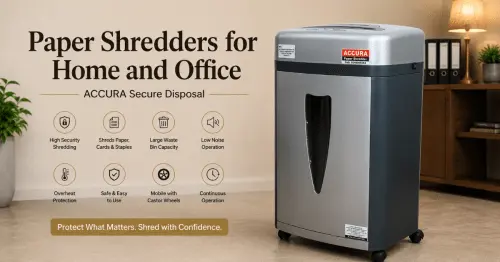
Sensitive paper documents continue to accumulate in Indian homes and offices even in a digital age. Bank statements, old cheques, insurance papers, medical records, salary slips, tax documents, customer data and handwritten notes all contain information that can be misused if they fall into the wrong hands. Simply throwing these papers into the regular dustbin or selling them to a kabadiwala creates a clear risk of identity theft, financial fraud and privacy breaches. A paper shredder for home and office provides the simplest and most reliable way to destroy such documents beyond reconstruction.
A good paper shredder cuts sheets into fine particles or thin strips that cannot be easily reassembled. Cross-cut and micro-cut models offer higher security than basic strip-cut machines. For households and small offices that regularly dispose of confidential papers, a quality shredder is an inexpensive yet highly effective security tool.
Why Secure Document Destruction Matters
Identity theft and document-based fraud remain real risks. Discarded papers can reveal account numbers, addresses, signatures, medical history or business information. Even a single bank statement or old cheque can give a fraudster enough detail to attempt misuse. In offices, customer lists, employee records and financial printouts require the same careful disposal.
Many people assume that tearing papers by hand or burning them is sufficient. Hand-torn pieces can often be reassembled, and burning is impractical or restricted in many residential and commercial settings. A paper shredder for home and office produces consistent, fine destruction with minimal effort and no open flame. Once shredded, the particles are far harder to exploit and can be disposed of with ordinary dry waste or sent for recycling where facilities exist.
Types of Shredding Technology
Understanding the main cut types helps in choosing the right machine:
- Strip-cut: Cuts paper into long vertical strips. Fast and suitable for low-security everyday waste, but strips can sometimes be reassembled with effort.
- Cross-cut: Cuts in both directions, producing small rectangular confetti-like particles. This is the practical standard for most homes and small offices because it balances speed, security and price.
- Micro-cut / high-security cut: Produces even smaller particles for maximum security. Ideal when highly sensitive data is involved, though these machines are usually slower and more expensive.
For the majority of Indian households and small businesses, a cross-cut paper shredder for home and office offers the best combination of security and usability.
Key Features to Evaluate
When selecting a paper shredder, consider these practical points:
- Sheet capacity: How many sheets can be fed at once (commonly 5–15 sheets for home and small-office models). Higher capacity reduces the time spent shredding large piles.
- Cut type and security level: Cross-cut is recommended for general confidential documents.
- Run time and cool-down: Continuous-run machines can operate longer before needing a rest period. Important if you occasionally shred large volumes.
- Bin capacity: A larger waste bin means fewer trips to empty it. Transparent or easily accessible bins help monitor fill level.
- Jam protection: Auto-reverse or anti-jam features save time and frustration when too many sheets or staples are inserted.
- Noise level: Quieter motors are preferable for home use or shared office spaces.
- Safety features: Safety locks, finger-safe feed openings and overload protection are valuable, especially in homes with children.
- Ability to handle staples and paper clips: Most modern machines accept small staples; removing large clips is still good practice.
- Credit-card and optical-media slots: Some models can also destroy old cards and CDs, adding extra utility.
A machine that is too small for the typical volume leads to frequent emptying and overheating. One that is unnecessarily large wastes space and money. Matching capacity to actual weekly document volume produces the best results.
Practical Use in Homes and Offices
In homes, a paper shredder for home and office is typically used for old bank statements, expired insurance papers, medical bills, school records and any document containing personal identifiers. Many families set aside a small box for papers to be shredded and process them once a week or every fortnight.
In offices and clinics, the same machine handles customer forms, printed emails with sensitive data, old invoices and employee-related printouts. Establishing a simple rule — “if it has a name, account number or address, it gets shredded” — prevents confidential papers from entering the general waste stream.
Place the shredder in a convenient but out-of-the-way location: a home office corner, under a desk, or near the area where paperwork is processed. Keep the surrounding area tidy so that papers do not accumulate in unsafe piles. Empty the bin regularly; overfilled bins increase the chance of jams and reduce efficiency.
Benefits Beyond Security
Apart from protecting against identity theft, a shredder supports better organisation. Old papers no longer clutter drawers and cupboards. Once destroyed, the volume of waste is reduced and can often be recycled. Staff and family members develop better document-handling habits when a clear destruction method is available. For businesses, demonstrating secure disposal practices can also support compliance with basic data-protection expectations.
Common Mistakes to Avoid
Buying the cheapest strip-cut model and assuming it provides adequate security is a frequent error. Overloading the machine beyond its sheet rating causes jams and shortens lifespan. Neglecting to empty the bin leads to reduced performance. Shredding wet, laminated or excessively crumpled papers increases wear. Leaving the shredder accessible to young children without safety locks creates unnecessary risk. Choosing a machine with very short run time for an office that occasionally processes large batches results in repeated waiting periods.
Conclusion
A paper shredder for home and office is a simple, low-cost tool that delivers high-impact protection against document-based identity theft and privacy breaches. Cross-cut destruction, adequate sheet capacity, anti-jam features and basic safety functions turn confidential paper waste into unreadable particles quickly and reliably. For any household or small business that regularly discards sensitive documents, it is one of the most practical security investments available.
ACCURA paper shredders are designed for dependable everyday use in Indian homes and offices. ACCURA models focus on effective cross-cut performance, practical sheet capacity, solid build quality, useful safety and anti-jam features, and straightforward operation that requires minimal training. Whether you need a compact unit for household documents or a more robust machine for small-office volumes, ACCURA provides reliable secure disposal that helps protect personal and business information. Supported by clear guidance and service backup, an ACCURA paper shredder makes confidential document destruction a routine, hassle-free part of responsible information handling.
FAQs
Q: What cut type is best for a paper shredder for home and office? A: Cross-cut is the recommended standard for most users. It produces small particles that are very difficult to reassemble while remaining affordable and reasonably fast.
Q: How many sheets should the shredder handle at once? A: 6–12 sheets is practical for most homes and small offices. Higher capacity is useful if large volumes are shredded regularly.
Q: Can paper shredders destroy credit cards and CDs? A: Many models include a separate slot for old credit cards and optical discs. Check the specifications of the specific machine.
Q: How often should the bin be emptied? A: Empty it before it becomes completely full. Overfilled bins increase the likelihood of jams and reduce efficiency.
Q: Are paper shredders safe to use around children? A: Choose models with safety locks and finger-safe openings, and store or disable the machine when not in use if young children are present.