
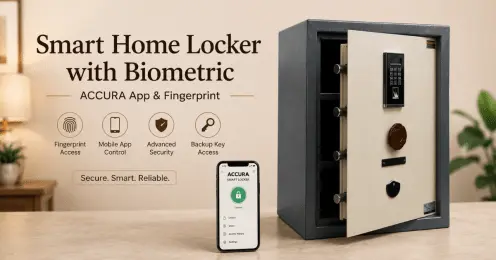
Home security has moved beyond simple keys and basic digital codes. Today’s families expect faster access, better control over who can open the safe, and optional connectivity that fits modern lifestyles. A smart home locker with biometric technology meets these expectations by combining fingerprint recognition, digital PIN access, an emergency mechanical key, and, on advanced models, mobile-app features. The result is a high-security storage solution that feels convenient in daily use while remaining extremely difficult for unauthorised persons to breach.
A smart home locker with biometric typically stores multiple fingerprints, supports one or more PINs, and retains a physical override key. Some versions add Bluetooth or app-based functions such as access logs, temporary codes, or remote status checks. When built with proper steel thickness and securely mounted, it becomes a practical, future-ready vault for jewellery, cash, documents and other valuables inside Indian homes.
Why Smart Biometric Lockers Are Gaining Popularity
Traditional mechanical lockers depend entirely on keys that can be lost, copied or shared without control. Pure digital lockers require remembering codes and carry the risk of someone observing the entry. A smart home locker with biometric removes both limitations. Authorised users open the door in under a second with a fingerprint. Multiple family members can be registered. Temporary or one-time codes can be issued when needed. Access history, where available through an app, provides an additional layer of accountability.
Urban lifestyles, dual-income households and the high value of gold have increased the demand for both speed and control. Elderly family members benefit from simple fingerprint access. Homes with domestic staff gain the ability to restrict entry without awkward conversations. Frequent travellers appreciate the option of granting limited access to a trusted person while they are away. These real-world needs explain why smart biometric models are becoming the preferred choice for many buyers.
How a Smart Biometric Home Locker Works
The core of the system is the fingerprint scanner — usually an optical or capacitive sensor capable of storing 10–25 or more impressions. When a registered finger is placed correctly, the system matches the template and releases the locking bolts, often in less than one second. If the scanner has difficulty (wet, dry or injured finger), the user can switch to the PIN keypad. If both electronic methods are unavailable due to complete battery failure, the emergency mechanical key provides access.
On models with app connectivity, the locker can communicate via Bluetooth or similar short-range technology. Users may view recent access events, generate time-limited codes, or receive low-battery and tamper alerts on their phone. These features remain secondary to the primary physical and biometric security; the locker continues to function fully even if the phone is not present.
Battery life is typically 12–24 months under normal household use. Low-battery indicators give advance warning. Some designs include external power contacts so a temporary battery pack can restore keypad function if internal cells are completely drained.
Key Features to Look For
When evaluating a smart home locker with biometric, focus on these practical points:
- Reliable biometric scanner: High recognition accuracy, reasonable storage capacity for multiple users, and consistent performance in normal Indian home conditions.
- Dual or triple locking: Fingerprint + PIN + emergency mechanical key is the recommended combination. Never rely on biometrics or electronics alone.
- Steel construction: Body thickness of at least 2–3 mm and door thickness of 5–6 mm. Single-sheet moulding and powder-coated finishes improve strength and corrosion resistance.
- Mounting provision: Pre-drilled holes for wall or floor bolting are essential. An unbolted locker can still be removed.
- App or smart features (where present): Access logs, temporary codes, and status alerts are useful extras but should not replace core physical security.
- Internal organisation: Shelves or compartments help keep jewellery, documents and cash orderly.
- User management: Easy registration and deletion of fingerprints and PINs suit changing family needs.
- Alarms and indicators: Tamper alerts, wrong-attempt lockouts and low-battery warnings increase practical security.
Capacity selection follows standard guidelines. Compact units (15–25 litres) suit personal jewellery and documents. Medium family sizes (35–45 litres) handle full collections plus paperwork. Larger models serve joint families or home-office requirements.
Placement, Installation and Daily Use
Choose a discreet yet convenient location — master bedroom, wardrobe interior, or secure storage area. Ensure the position allows comfortable finger placement on the scanner and full door opening. Bolting to a solid wall or floor is mandatory for maximum theft resistance.
After installation, register primary and secondary fingerprints carefully, set a strong PIN, test the emergency key, and store the override key in a separate secure place. If the model includes app features, complete the pairing process and explore the available functions. Establish a simple household routine so that valuables are consistently returned to the locker after use.
Keep the scanner surface clean with a soft dry cloth. Check batteries every six months. Re-register a fingerprint if recognition becomes inconsistent due to changes in skin condition.
Practical Benefits for Modern Households
A smart home locker with biometric delivers speed, control and accountability that older systems cannot match. Authorised access is nearly instantaneous. Unauthorised sharing of keys or codes becomes far more difficult. Optional app features provide visibility into who opened the locker and when. The physical strength of proper steel construction and secure mounting protects against forced removal and prying.
For jewellery-heavy families, the combination of fast fingerprint entry and organised internal space is especially valuable during festivals and functions. Documents and emergency cash remain protected yet instantly available. Over the long term the one-time cost is usually lower than repeated bank locker rentals, while control stays entirely with the family.
Common Mistakes to Avoid
Buyers sometimes prioritise app features while accepting thin steel or single locking. Others skip bolting or store the emergency key inside the locker. Poor fingerprint registration (wet fingers, partial placement) leads to later frustration. Over-reliance on the smartphone for access can create problems if the phone is lost or the battery is dead — the physical and biometric systems must remain fully independent. Choosing capacity based only on current needs without allowing for growth is another frequent error.
Conclusion
A smart home locker with biometric technology represents the current practical standard for households that want both high security and modern convenience. Fingerprint recognition, PIN backup, emergency key, solid steel construction and optional smart features combine to create a storage solution that fits contemporary Indian lifestyles while protecting jewellery, documents and cash effectively.
ACCURA smart home lockers with biometric are engineered to deliver exactly this balance. ACCURA models feature reliable fingerprint scanners capable of storing multiple impressions, dual locking systems that combine biometric access with digital PIN and mechanical emergency key, robust mild-steel construction (typically 3 mm body and 6 mm door), single-sheet moulding, powder-coated rust-resistant finishes, pre-drilled mounting points, practical internal layouts, and, on selected versions, useful app-connected functions such as access visibility and alerts. Whether you need a compact personal unit or a larger family-sized model, ACCURA provides modern, dependable security backed by clear installation guidance and multi-year service support. Choosing an ACCURA smart home locker with biometric means securing your valuables with technology that is both advanced and grounded in real everyday reliability.
FAQs
Q: How many fingerprints can a smart home locker with biometric usually store? A: Most quality models store 10–25 fingerprints or more, allowing several family members to register.
Q: What happens if the smartphone or app is unavailable? A: The locker continues to function fully with fingerprint, PIN and emergency key. App features are optional extras, not a requirement for access.
Q: Is a smart biometric locker still safe if the batteries die? A: Yes. The emergency mechanical key provides access. Low-battery indicators give advance warning so complete depletion is rare with normal maintenance.
Q: Does a smart home locker with biometric need to be bolted down? A: Yes. Bolting prevents the entire unit from being removed and remains one of the most important security steps.
Q: Are app features necessary for good security? A: No. Core security comes from the steel construction, dual locking and proper mounting. App functions add convenience and visibility but are secondary.