
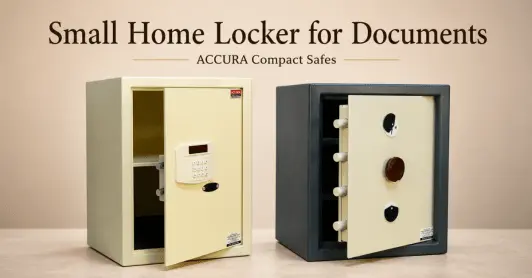
Important documents are among the most frequently needed yet most vulnerable items in an Indian household. Passports, property papers, insurance policies, fixed-deposit receipts, Aadhaar and PAN cards, wills and educational certificates are required for travel, loans, medical emergencies, legal processes and official work. Storing them in ordinary drawers, plastic folders or open shelves leaves them exposed to theft, accidental damage, water leakage and fire. A small home locker for documents solves this problem by providing compact, dedicated, high-security storage that fits easily into wardrobes, cupboards or bedside spaces while remaining accessible whenever required.
A small home locker for documents is typically in the 12–25 litre range. It is designed to hold A4-sized files, passports, cash bundles and a limited amount of jewellery without occupying excessive space. Digital PIN or biometric fingerprint access combined with an emergency mechanical key delivers convenient daily use and reliable backup. When properly bolted, the unit offers far stronger protection than any piece of furniture.
Why Documents Need Dedicated Secure Storage
Many families underestimate the risk to paperwork until an incident occurs. Theft of original property documents can create lengthy legal complications. Loss of passports disrupts travel plans. Water damage from a leaking roof or air-conditioner can render insurance policies and certificates unusable. Fire, even a limited kitchen or electrical fire, can destroy paper records within minutes.
Bank lockers provide institutional security but restrict access to banking hours and often involve waiting lists and annual fees. For documents that may be needed at short notice — medical emergencies, sudden travel, loan processing or police verification — a small home locker for documents keeps everything under the family’s direct control and available 24 hours a day.
Ideal Capacity and What Fits Inside
Compact lockers in the 12–20 litre range comfortably hold:
- Multiple passports and visa documents
- Property papers and sale deeds (folded or in slim folders)
- Insurance policies and premium receipts
- Fixed-deposit and investment certificates
- Aadhaar, PAN and educational certificates
- A modest emergency cash reserve
- A few pieces of frequently used jewellery if needed
Slightly larger compact models (around 25 litres) add room for thicker files or additional cash. The key is to choose a size that allows organised storage without excessive empty space that encourages overfilling later. Internal shelves or simple dividers help keep papers flat and prevent creasing.
Essential Features of a Good Small Home Locker for Documents
When selecting a unit, prioritise these practical points:
- Steel construction: Body thickness of at least 2–3 mm and door thickness of 5–6 mm provide real resistance to prying. Single-sheet moulding and powder-coated finishes improve durability in humid conditions.
- Dual locking system: Digital PIN keypad or biometric fingerprint scanner plus an emergency mechanical key is the recommended combination. Auto-lockout after repeated wrong attempts adds protection.
- Compact external dimensions: The locker should fit inside a standard wardrobe, cupboard or under a bed without major rearrangement of the room.
- Pre-drilled mounting holes: Bolting to a wall or solid floor is essential. An unbolted small locker can still be removed quickly.
- Internal organisation: At least one shelf or the ability to stand files upright helps maintain order and reduces damage to documents.
- Battery indicators and backup access: Low-battery warnings and a reliable emergency key prevent lockouts.
- Weight and stability: Even compact models should feel substantial once bolted.
Digital models are popular because PINs are easy for multiple family members to use. Biometric versions offer faster access for authorised users and reduce the risk of codes being observed or shared. Both work well when paired with the mechanical override key.
Placement and Installation Tips
The best locations for a small home locker for documents are discreet yet convenient: inside a master-bedroom wardrobe, a dedicated storage cupboard, or a secure corner of a home office. Avoid placing it near the main entrance, kitchen or obvious high-traffic areas. Ensure the chosen spot allows the door to open fully and the user to operate the keypad or scanner comfortably.
Bolting is non-negotiable. Use the supplied anchors and confirm the mounting surface can support the weight. After installation, change any factory default PIN immediately, register fingerprints if applicable, test the emergency key, and store the override key in a separate secure location known only to trusted adults. Keep a simple inventory of the contents so that documents can be located quickly when needed.
Everyday Benefits
A small home locker for documents delivers several practical advantages. Critical papers remain protected from casual viewing by visitors or household staff. Retrieval is possible at any hour without travel to a bank. The compact size makes it suitable for apartments and smaller homes where floor space is limited. Organised storage reduces the chance of documents being misplaced or damaged during routine household activity.
Over time the one-time cost is usually lower than repeated bank locker rentals, especially when the documents in question are accessed more than a few times a year. Families also gain peace of mind knowing that passports and property papers are secured against common household risks.
Common Mistakes to Avoid
Buyers sometimes choose an extremely cheap thin-walled box that offers little real security. Others skip bolting or store the emergency key inside the locker itself. Overfilling a small unit forces documents to be folded tightly, increasing the risk of damage. Selecting a model without dual locking or battery indicators creates unnecessary future frustration. Taking time to match capacity, construction and access method to actual document volume prevents these errors.
Conclusion
A small home locker for documents provides focused, convenient and strong protection for the papers Indian families need most often. Compact size, dual locking, proper steel construction and secure mounting combine to create a practical daily security solution that ordinary furniture cannot match.
ACCURA small home lockers for documents are designed with exactly these requirements in mind. ACCURA compact models feature robust mild-steel construction (typically 3 mm body and 6 mm door), single-sheet moulding, powder-coated rust-resistant finishes, dual locking systems (digital PIN or biometric fingerprint plus emergency mechanical key), pre-drilled mounting holes for secure bolting, and practical internal layouts suitable for passports, files and limited valuables. Whether you prefer a simple digital unit or a biometric version, ACCURA offers reliable compact protection backed by clear installation guidance and multi-year service support. Choosing an ACCURA small home locker for documents means keeping your most important papers secure, organised and accessible whenever life requires them.
FAQs
Q: What size is ideal for a small home locker for documents? A: 12–20 litres suits most households for passports, property papers, insurance documents and limited cash. Around 25 litres provides extra room if needed.
Q: Can a small locker also hold some jewellery? A: Yes. Many compact models accommodate a modest amount of frequently used jewellery along with documents, provided the space is organised properly.
Q: Is digital or biometric better for document storage? A: Both work well with an emergency key backup. Digital PIN is simple for multiple users; biometric offers faster authorised access.
Q: Must a small home locker still be bolted down? A: Yes. Even compact units should be bolted to a wall or floor to prevent removal during a break-in.
Q: How should documents be stored inside to avoid damage? A: Use slim folders or keep papers flat on shelves. Avoid overfilling so that files are not forced into tight bends.