
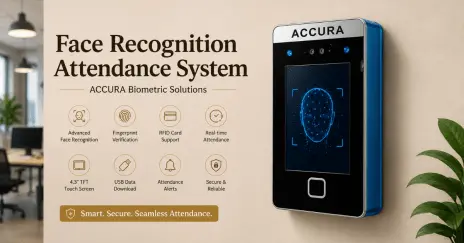
Accurate attendance tracking remains a fundamental requirement for offices, factories, schools, hospitals and any organisation that manages a workforce. Traditional methods — manual registers, punch cards or basic fingerprint scanners — suffer from well-known problems: buddy punching, queues at peak hours, hygiene concerns and time-consuming reconciliation. A face recognition attendance system eliminates most of these issues by identifying employees through their facial features in a contactless, rapid and highly accurate manner.
Modern face recognition attendance systems use cameras and AI algorithms to match a live face against a pre-registered database in under a second. Because no physical contact is required, the process is hygienic and fast. Proxy attendance becomes extremely difficult, queues disappear, and attendance data flows automatically into payroll or HR software. For Indian organisations of almost any size, this technology has moved from optional luxury to practical operational tool.
Why Organisations Are Adopting Face Recognition Attendance
Buddy punching — one employee marking attendance for another — remains a costly problem in many workplaces. Fingerprint systems reduce it but still require contact and can struggle with dirty, wet or worn fingers common in industrial environments. Manual registers are slow and easily manipulated. Card-based systems are vulnerable to sharing or loss.
A face recognition attendance system addresses these weaknesses directly. Each person must be physically present for their own face to be recognised. Recognition typically takes less than one second, allowing large numbers of employees to pass through entry points without forming queues. The contactless nature improves hygiene — an important consideration in shared workplaces. Data is captured digitally and can be integrated with payroll, reducing manual errors and administrative workload.
Schools use the same technology for student and staff attendance, often with automated parent alerts. Factories and construction sites benefit from rugged devices that work in varied lighting. Offices appreciate the clean, modern experience and the elimination of time theft.
How a Face Recognition Attendance System Works
The process is straightforward. During enrolment, clear images of each employee’s face are captured and converted into a secure mathematical template (not a photograph stored for casual viewing). At the attendance point, a camera captures the live face, the system extracts features, and matches them against the enrolled templates. When a match is found with sufficient confidence, attendance is recorded with a timestamp and, in many systems, a location or device ID.
Advanced systems include liveness detection to prevent spoofing with photographs, videos or masks. Some support mask detection or work effectively even when employees wear light face coverings. Recognition can occur in a range of lighting conditions, although consistent illumination improves performance. Many devices function offline and synchronise data when connectivity is restored — a practical advantage in areas with unstable internet.
Data is typically stored on a local device, a dedicated server, or a secure cloud platform, depending on the organisation’s preference and compliance requirements. Integration with existing HR or payroll software allows automatic calculation of working hours, overtime and leave.
Key Features to Evaluate
When selecting a face recognition attendance system, consider these practical aspects:
- Recognition speed and accuracy: Sub-second recognition with high accuracy rates (typically above 99 % under normal conditions) is expected from quality systems.
- Liveness detection: Essential to block attempts to use photos or videos.
- User capacity: The system should support the current workforce with room for growth.
- Lighting performance: Ability to work in indoor office light, factory floor conditions, and varying outdoor light if needed.
- Offline capability: Local storage and later synchronisation prevent data loss during network outages.
- Integration options: Compatibility with common payroll and HR platforms reduces manual work.
- Device options: Wall-mounted terminals, desktop units, or mobile/app-based solutions for field staff.
- Multi-authentication: Some systems combine face recognition with PIN, card or fingerprint as backup.
- Reporting and alerts: Real-time dashboards, late-coming reports, and absence notifications improve management visibility.
- Data security and compliance: Encryption, access controls and alignment with applicable Indian data-protection requirements.
Organisations should also assess installation environment — indoor versus outdoor, single versus multiple entry points — and decide whether a pure hardware terminal or a software-plus-camera approach better suits their needs.
Implementation and Daily Use
Successful deployment begins with clear communication to employees about the purpose (accurate attendance and operational efficiency) and the data-handling practices. Enrolment should be done carefully with good-quality images under consistent lighting. Multiple entry points may require networked devices that share the same user database.
Once live, the system requires minimal daily intervention. Managers monitor dashboards for exceptions rather than collecting paper registers. Periodic cleaning of camera lenses and verification of data synchronisation keep the system reliable. In factories or outdoor locations, protective housings and stable power supplies improve uptime.
For organisations with field staff, mobile face-recognition apps with GPS tagging extend the same accuracy beyond the fixed workplace.
Benefits Across Different Sectors
Offices gain clean, queue-free entry and automatic payroll inputs. Factories reduce time theft and improve shift management. Schools obtain reliable student attendance with optional parent notifications. Hospitals and clinics maintain hygiene while tracking staff movement. In all cases, the reduction in administrative effort and the improvement in data accuracy deliver measurable operational gains.
When combined with access-control functions, the same face recognition platform can also restrict entry to sensitive areas, creating a unified identity and attendance layer.
Common Mistakes to Avoid
Choosing a system solely on lowest price often leads to poor accuracy, weak liveness detection or limited support. Neglecting employee communication creates resistance. Poor enrolment images cause later recognition failures. Ignoring lighting conditions at installation points reduces performance. Failing to plan for data integration leaves organisations with accurate attendance data that still requires manual transfer into payroll. Treating the system as a complete security solution rather than one layer among several is another frequent error.
Conclusion
A face recognition attendance system delivers fast, contactless, accurate and proxy-resistant attendance tracking for modern Indian workplaces. By replacing manual registers, cards and basic biometric devices with reliable facial identification, organisations reduce time theft, eliminate queues, improve hygiene and feed clean data directly into payroll and HR processes. The technology has matured into a practical tool suitable for offices, factories, schools and other institutions of varying sizes.
ACCURA face recognition attendance systems are designed for dependable performance in real Indian working environments. ACCURA solutions emphasise rapid and accurate recognition, effective liveness detection, practical user capacity, offline capability, straightforward integration options and robust construction suitable for daily commercial use. Whether deployed as wall-mounted terminals at factory gates or as part of an office entry system, ACCURA provides reliable attendance automation that helps organisations save time, improve accuracy and maintain better operational control. Supported by clear implementation guidance and service backup, an ACCURA face recognition attendance system turns attendance from a daily administrative burden into a smooth, automated process.
FAQs
Q: How accurate is a face recognition attendance system? A: Quality systems typically achieve recognition accuracy above 99 % under normal lighting and enrolment conditions, with liveness detection to prevent photo or video spoofing.
Q: Does the system work if employees wear masks? A: Many modern systems include mask-detection or mask-tolerant recognition modes. Performance is best when the system is specifically configured for the expected conditions.
Q: Can face recognition attendance systems function without internet? A: Yes. Most devices store records locally and synchronise automatically when connectivity is restored.
Q: Is face recognition suitable for factories and outdoor areas? A: Yes, provided the devices are chosen for the lighting and environmental conditions and installed with appropriate protection.
Q: How does the system prevent buddy punching? A: Because each person must present their own live face for recognition, it is extremely difficult for one employee to mark attendance for another.